Mas d’Amile, Terrasses du Larzac
| Country & Region | France, Languedoc |
| Appellation(s) | Terrasses du Larzac |
| Producer | Amélie and Jérôme d’Hurlaborde |
| Founded | 2007; property in the family for 3 generations |
| Website | https://masdamile.fr/historique/ |
A mélie d’Hurlaborde started Mas d’Amile with her brother Sébastien in 2007, when they inherited a 2.5-acre parcel of old Carignan from their grandfather. Amélie did graphic arts and writing for producers in the southern Rhône; Sébastien was the main vineyard guy and GM for a local biodynamic domaine, and they had planned for this moment. As soon as the inheritance came through, they took over the parcel and made the wine from that year’s crop in their grandfather’s garage.
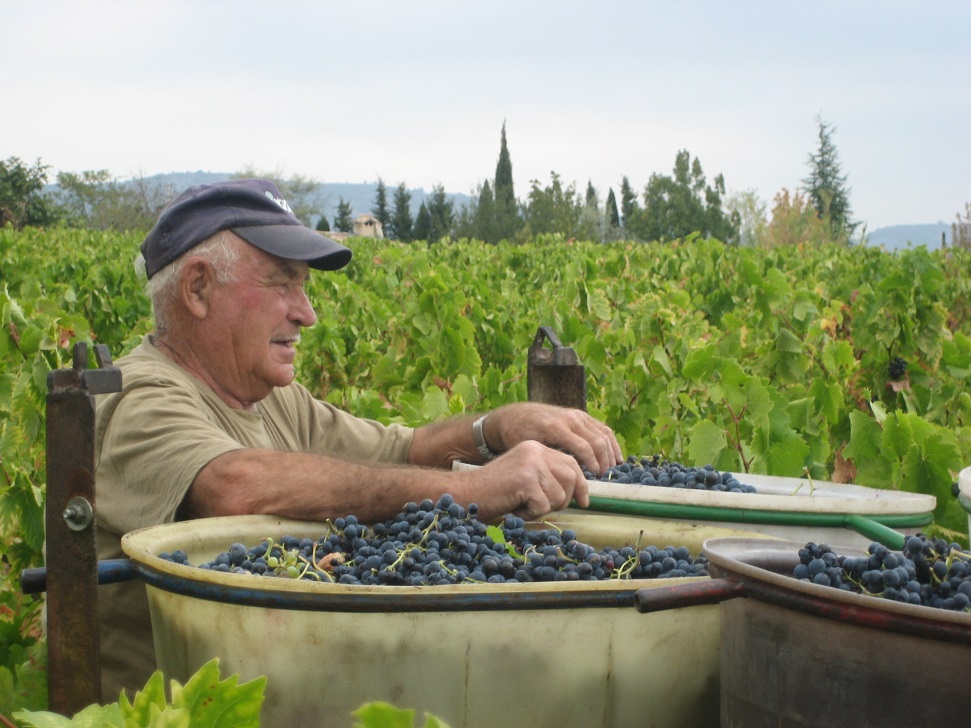
Grandpa was okay with that. He is pictured above during the 2007 harvest. He had been a grower all his life, selling the crop to the co-op (plus he was one of the village mailmen; he knew everyone!). His father came from Spain and ended up marrying a local woman whose roots went back to 17th century Montpeyroux. When Amélie was born, Grandpa bestowed the nickname of Amile upon her—the masculine version of her name—and in one sense anyway things came full circle when she made her wine under that name in his garage.
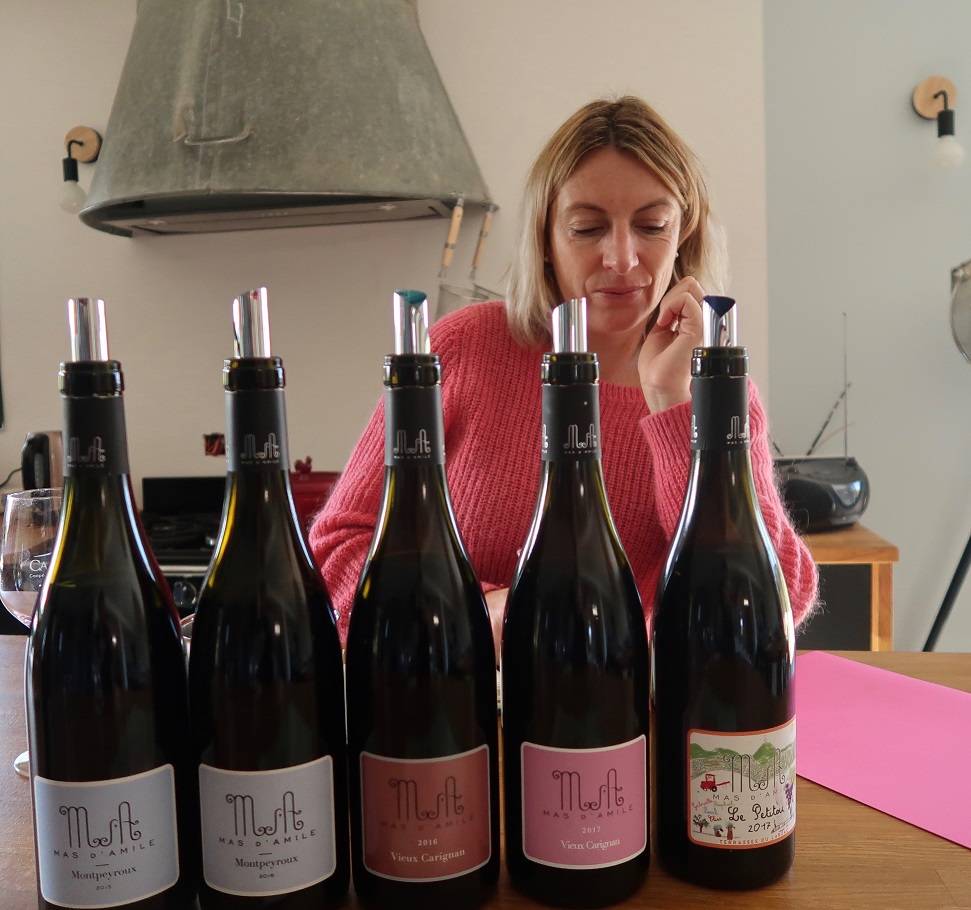
While brother Sébastien kept his day job, Amélie never looked back. Montpeyroux’s well-known vigneron Sylvain Fadat, along with her father (the village’s popular, longtime mayor), helped her gain the trust of growers, which opened the door to her to buy parcels from those taking their retirement. She now tends 14 parcels with 3 more being planted, doing nearly all of the farming herself with some help from her brother and from her husband Jérôme. These parcels total 21 acres, (to grow to 25 by 2028 when the new plantations come of age), all in the commune of Montpeyroux within the appellation of Terrasses du Larzac. The vines average 40-years, apart from the 1930s-era Carignan plantation. Since the beginning in 2007 she has worked without pesticides, herbicides or synthetic fungicides; in recent years, she’s been applying biodynamic treatments. She received official certification in France from Ecocert for organic viticulture in 2022.
Her parcels lie between 150-400 meters in elevation at the base of the Cevennes Mountains and its plateaux—which is to say, hard up against the Massif Central, a dramatic backdrop at the very end of the Languedoc plain, roughly 25 miles inland from the Mediterranean.
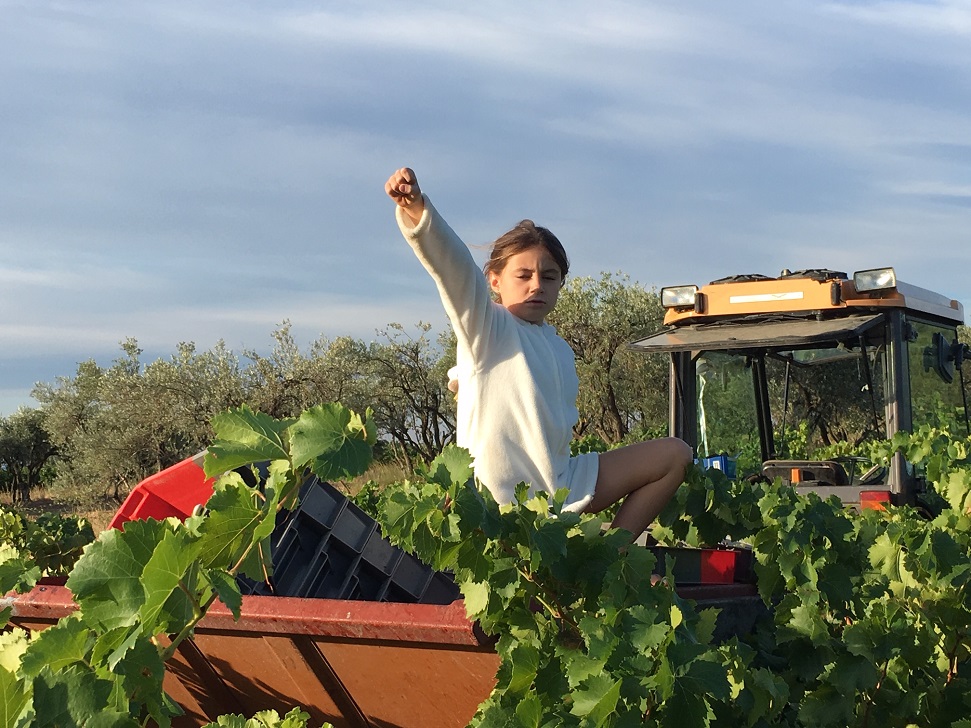
All of Amélie’s vines are hand-harvested by the extended family, and all ferments in the cellar are allowed to happen spontaneously. Below is her daughter Gabrielle during the 2019 harvest.
Terrasses du Larzac gained appellation status in 2014. Its cru is the village of Montpeyroux, the old staging area for trade between the interior and the coast. Standing alone between Faugères and Pic St Loup, the appellation is a hotbed of cutting-edge production these days, and it’s easy to see why. Its soil is limestone rubble and is wildly infertile (the very name Montpeyroux refers to stony or rocky mountain); its elevations are high; and its diurnal shifts are radical—temperatures can drop as much as 68°F at night thanks to the cold air sweeping off the imposing Larzac plateau, making this one of Languedoc’s latest ripening appellations. Its best wines distill the essence of Languedoc: soaring aromatics, spice, garrigue, and succulent notes of tapenade, with length and elegance in place of extracted power (it’s possible to go for power here, and some do, but most have seen the light). The vast majority of producers work organically or biodynamically.
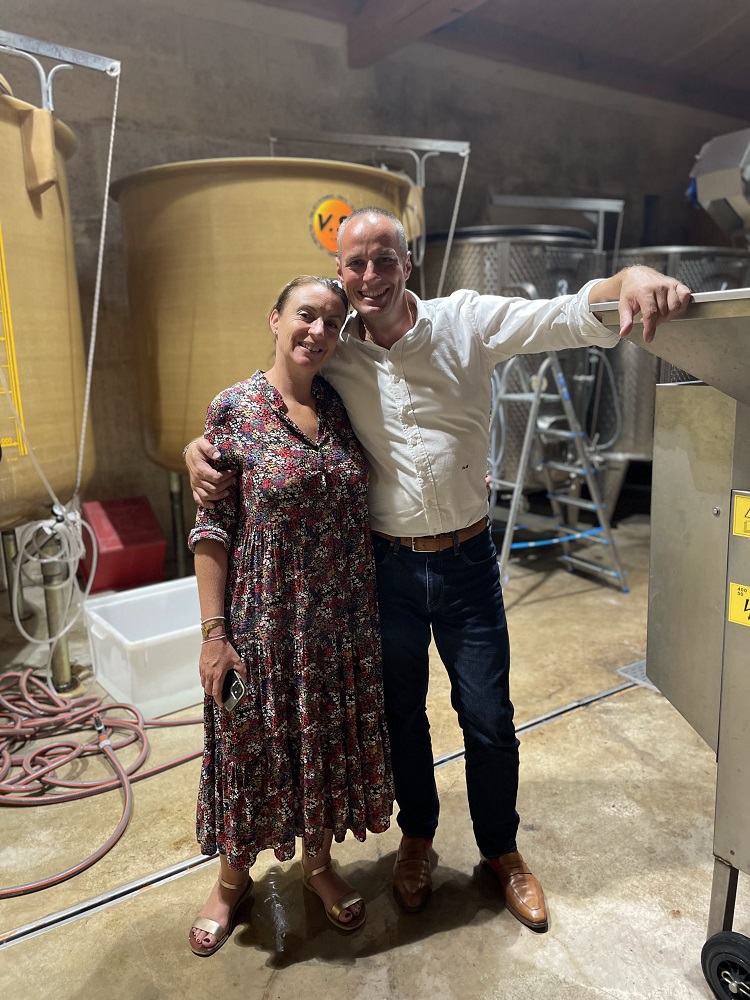
Amélie’s brother Sébastien still consults (He’s the best consultant! she contends), but he’s taking more of a backseat role while husband Jérôme is stepping in when time permits (his day job is sales director for Jean-Claude Boisset’s group of French domaines).
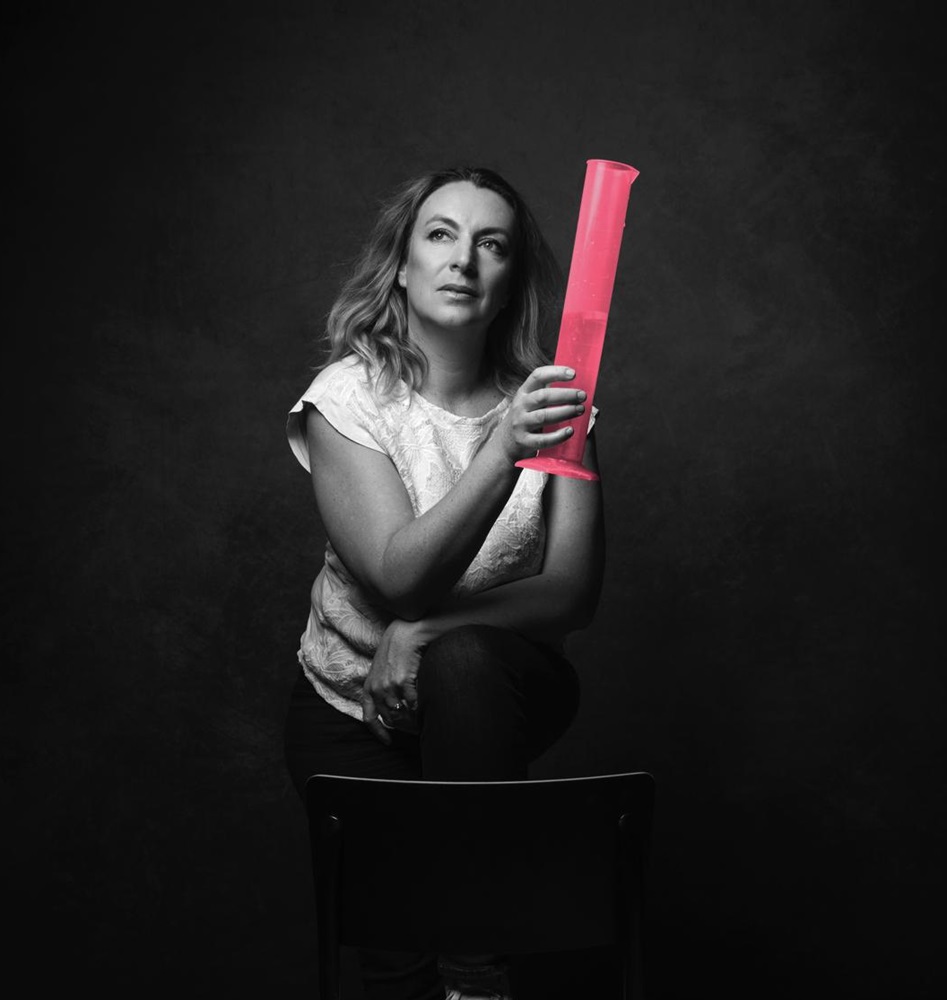
In 2024 Amélie participated in the October Rose promotion with a group of growers for breast cancer research, photographed with a tool of her trade (a hydrometer cylinder used for measuring specific gravity in winemaking) colored in pink. That night, the Eiffel Tower was similarly lit up in pink. Photo credit to Jourdan Couche Photographie.
The Wines
| Wine | Blend | Description |
|---|---|---|
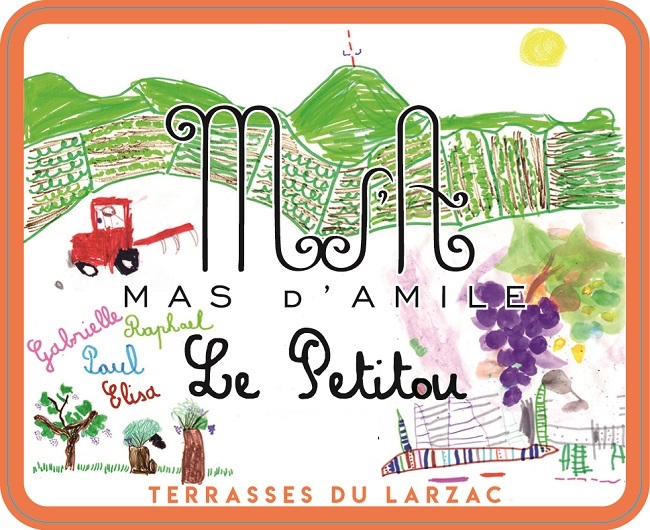
| Le Petitou | Roughly 60% Grenache with Syrah and Carignan | Originally, this was to be a rosé, but Amélie didn't like the result, so she decided to make a lighter, more elegant and refreshing red. The base of Grenache comes from an old hillside vineyard just behind their house and winery, which in turn is immediately south of the village of Montpeyroux, while the Syrah and Carignan come from nearby sites. The wine sings of its Mediterranean heritage, rich with licorice and tapenade in a long, lean, tension-filled profile. And check out its refreshingly low alcohol! The grapes are de-stemmed and raised entirely in tank. The SO2 additions are minimal and done following devatting, then again during élevage, and a third time after blending. Typically the total amounts to 25 mg/l, which is less than Demeter's threshold for natural wines (Demeter's thresholds are 100 mg/l for organic wines; 70 mg/l for biodynamic wines; and 30 mg/l for natural wines). The label was designed by her daughter Gabrielle and son Paul (then six and four respectively) with help from friends. That, plus the fact that the cuvée is the most recent in the domaine's range, accounts for the name Petitou--in spirit, the little one. Production averages 7,500 bottles. Tech sheet here |
| Vieux Carignan | Carignan | A traditional variety of Languedoc, Carignan fell out of favor during the wine revival late in the last century as authorities focused on "ameliorating" grapes such as Grenache, Syrah and Mourvèdre. But as it has over the centuries, Carignan persisted--because it tolerates arid conditions, maintaining dark color and good acidity despite heat and drought; and because experienced growers understood that well-sited, old vine Carignan is something to treasure. The key is age above all. This wine can come from two plots totalling less than four acres planted in the 1930s in the commune of Montpeyroux (although normally for this cuvée, the source is confined to the larger plot of just over two acres). Fermentation is spontaneous and traditional (not carbonic), and the élevage goes for 18 months in neutral Burgundian barrels. Production averages 400/6-pack cases. Tech sheet here |
| Montpeyroux | Based on about 60% Grenache with roughly equal parts Carignan, Mourvèdre and Syrah | The grapes are de-stemmed with a light pressing. The élevage is in neutral oak barrels, 600L demi-muids and one foudre for 12 months. Minimal SO2 additions. An elegant, long and savory wine that is best decanted. Production averages 3,500-4,000 bottles. Tech sheet here |
| Le Clos | Grenache, Mourvèdre and Syrah | Le Clos is an isolated 2.22 acre parcel of vines on a south-facing slope surrounded by forest. It's in the commune of Montpeyroux but Amélie labels the wine under the Terrasses du Larzac appellation to keep it separate from her Montpeyroux bottling, which comes from a number of different sites scattered about the commune and is given a different élevage. Le Clos was planted in 2001 to 40% Grenache, 30% Mourvèdre and 30% Syrah. That reflects more or less the blend in the bottle. All of the varieties are hand-harvested, but the Syrah inevitably is harvested and vinified first, while the Grenache and Mourvèdre are normally harvested later and together and are co-fermented. All ferments are native, and the wine is aged for ~18 months in 600L demi-muids, 20% of which are new. A normal year sees 300 cases. |